EVerest: the open source software stack for EV chargers
Pionix started EVerest in 2020 and contributed it to LF Energy. We still write it, maintain it, and help manufacturers put it into shipping products.
What is EVerest?
EVerest is an open source software stack for EV charging stations, hosted by LF Energy under the Apache 2.0 licence. It handles the full charging path: the low level control logic between charger and vehicle, ISO 15118 communication and Plug and Charge, OCPP to the operator backend, energy management across multiple connectors, and drivers for the power meters, power modules and isolation monitors inside the cabinet. It runs on Linux, usually built with Yocto.
That covers AC wallboxes, DC fast chargers, and the megawatt class hardware now being built for trucks.
The short version for anyone comparing options: EVerest is the part of your charger that is the same as everyone else's charger. The protocol handling, the state machines, the certification-critical timing behaviour. None of it differentiates your product, all of it has to be perfect, and every manufacturer that writes it from scratch pays for the same work twice.
Who owns EVerest
Nobody owns it, and that is the point.
EVerest sits inside LF Energy, part of the Linux Foundation, governed by a Technical Steering Committee. Pionix holds a seat on that committee alongside chargebyte, Qwello, and the U.S. Department of Energy's DriveElectric programme. Around thirty further organisations contribute, and the numbers keep growing!
EVerest at LF EnergyPionix initiated the project in 2020 and remains its largest contributor. We did not keep it. A stack that every manufacturer is expected to build on cannot be controlled by one supplier, because the moment it is, it stops being infrastructure and starts being a lock-in risk. Neutral governance is what makes the stack safe to adopt, and it is the reason a charger manufacturer can build on EVerest without betting the roadmap on Pionix continuing to exist.
charger manufacturersEverything we write goes upstream. If you work with us and later decide to work with someone else, or with nobody, the code stays yours.
EVerest on GitHubWhat is inside the stack
The current release is 2026.02. Highlights of what ships in it:
| Area | What EVerest covers |
|---|---|
| Vehicle communication | ISO 15118-2 and ISO 15118-20, DIN 70121, SLAC, high level and basic charging |
| Plug and Charge | Certificate handling, contract certificate installation, EVSE security including TPM 2.0 |
| Backend protocols | OCPP 1.6 with all feature profiles, OCPP 2.0.1, OCPP 2.1 in active development |
| Charging logic | EvseManager, authorisation handling, multi-connector state management |
| Energy management | Load balancing across connectors and site limits, external energy management interfaces |
| Hardware drivers | Power meters, DC power modules, isolation monitors, NFC readers, contactor control |
| Testing | Vehicle and charger simulation modules, so you can test without a car and without a charger |
| Platform | Linux, Yocto integration, OTA update support |
The OCPP 2.0.1 implementation has been certified by the Open Charge Alliance on multiple hardware platforms and is continuously tested against OCTT2. That matters more than it sounds. A protocol implementation that has passed the compliance tool on real hardware is a different object from one that has passed unit tests, and the gap between the two is usually discovered late, in an integration lab, with a launch date already announced.
Note for the record: the standalone libocpp repository was archived in April 2026 and now lives inside the main EVerest repository, so anyone pointing at old links should update them.
Why manufacturers move to an open stack
Three arguments, in the order they usually land.
The protocol treadmill never stops. OCPP 1.6 to 2.0.1 to 2.1. ISO 15118-2 to -20. Plug and Charge, then bidirectional charging, then megawatt charging. Each one is a multi-engineer, multi-quarter project, and none of them wins you a single customer, because your competitors are shipping the same standard on the same deadline. Shared implementation work is the only sane response to a shared obligation.
Certification cost scales with how much code is yours alone. Test campaigns are expensive, and repeat campaigns for the sme protocol behaviour on slightly different firmware are the most expensive kind. A stack that has already been through OCA or Plug & Charge or ISO-level certification on other people's hardware starts you further along.
Buyers are asking harder questions. Charge point operators have been brned by chargers they could not update and vendors they could not replace. Open Source changes that conversation, and the tender language in Europe and North America has started to reflect it. The U.S. Joint Office of Energy and Transportation adopting EVerest for interoperability work is a signal about where procurement is heading.
There is a counterargument worth stating plainly, because every engineering manager raises it: an open stack you do not understand is a liability, not an asset. Reading 200,000 lines of C++ under deadline pressure is nobody's plan. Which brings us to the honest part.
How EVerest compares to proprietary stacks
In July 2026 we researched the significant proprietary charging station stacks: protocol libraries, turnkey controller platforms and vertically integrated hardware plus software bundles. The table condenses that research into the pattern a buyer actually faces. No vendors are named here, because the pattern matters more than the players, and because each vendor is strong in its own niche.
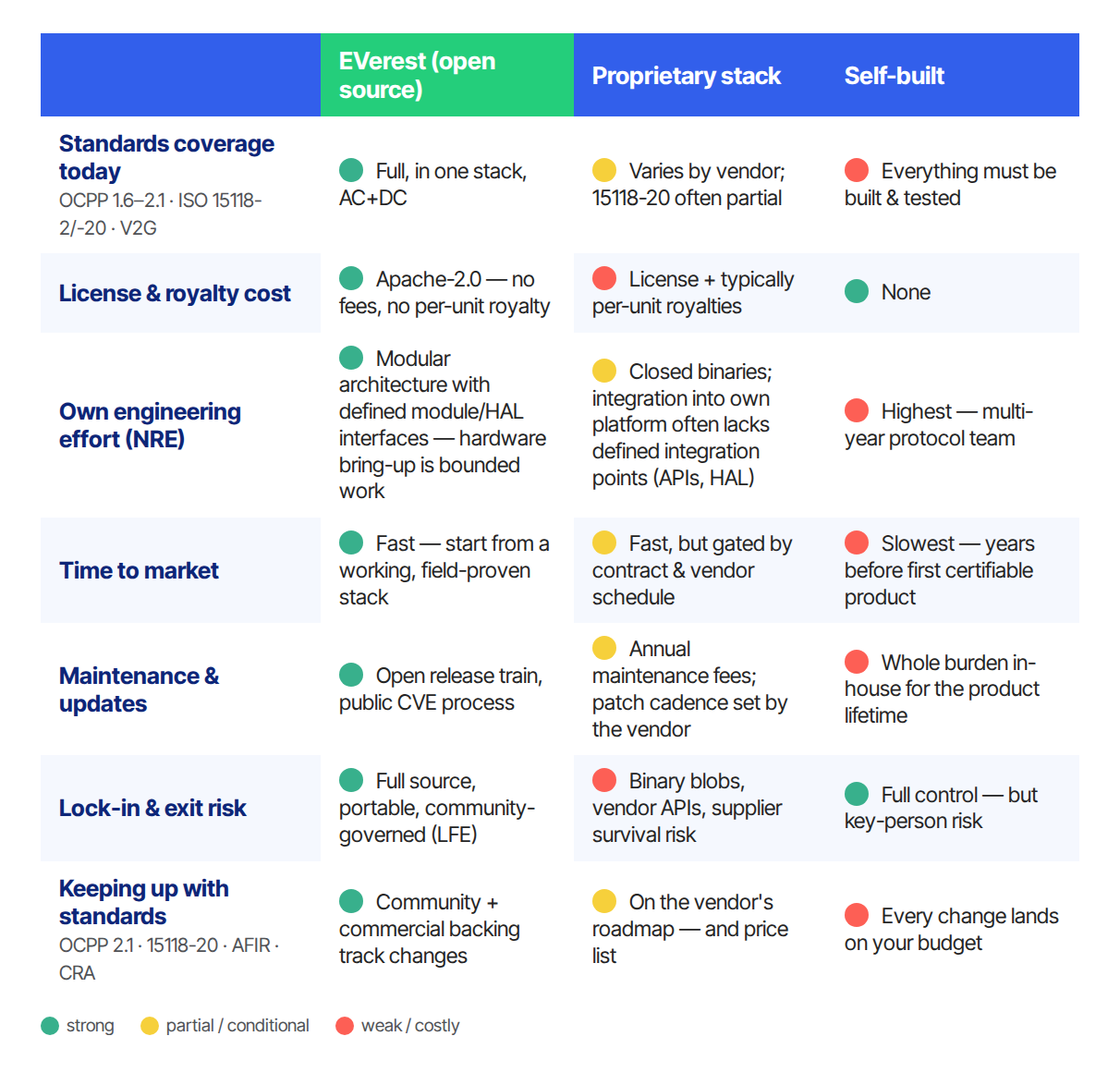
Text version of this comparison
| Dimension | EVerest (open source) | Typical proprietary stack |
|---|---|---|
| Scope | Full charger application: IEC 61851 state machine, authorization, OCPP, ISO 15118, energy management, hardware drivers. | Ranges from protocol libraries to full platforms. With library offers, the charger application around them is still yours to build. |
| OCPP | 1.6, 2.0.1 and 2.1 fully open source; the OCPP implementation is OCA-certified as a component. | 1.6 and 2.0.1 are common; newer versions are often tier-gated, roadmap items or marketing claims. |
| ISO 15118 and Plug & Charge | 15118-2, -3 (SLAC), -20 and DIN 70121 all in the open tree; first Hubject pre-certified stack, with certificate management built in. | Coverage is converging, but -20 and Plug & Charge are frequently sold as separately licensed, per-device feature activations. |
| Bidirectional charging | ISO 15118-20 bidirectional power transfer ships in the open stack. | Widely available, typically as a licensed option. |
| Source code access | 100% open under Apache 2.0, with fork rights. What you evaluate is what you ship. | Binary delivery is the norm. Source access, where offered at all, sits behind higher tiers and maintenance contracts. |
| License cost | Zero license fees and zero per-unit royalties, at any volume. Your costs are integration engineering and optional commercial support. | Quote-based per-device and feature-gated licensing is the norm. No vendor we examined publishes prices; at volume, per-device fees scale your unit cost. |
| Cost of standards churn | Amortized across the community. OCPP 2.1 and ISO 15118-20 landed in the tree without a per-customer upgrade fee. | Priced into maintenance and upgrade fees, and vendor speed varies. Three major protocol revisions in two years make this a recurring cost. |
| Security transparency | Public CVE process, OpenSSF badge, and an independent security audit in 2025 with all findings fixed and published. | Serious security engineering exists, but processes and audit results are usually not public. You rely on vendor assurances. |
| Lock-in and exit | Fork rights plus multiple competing suppliers of EVerest hardware, services and support. You can change vendors without re-platforming. | Switching costs by design; escrow agreements and long maintenance promises are the mitigation. Recent consolidation in this market shows the risk is not theoretical. |
| Supplier risk | The code outlives any single vendor: LF Energy owns the IP, and the worst case is that the stack simply stays open. | Risk concentrates in one company's viability and priorities. Open source degrades gracefully; a closed stack fails hard, with escrow as the best case. |
The research behind this table names the vendors and cites every source. If you are running an evaluation and want the full version, talk to our team.
What open source gives you, and what it does not
Downloading EVerest gets you a charging stack that works. It does not get you a product.
What is still on your side of the line:
- Your hardware. Your power stage, your meter, your contactors, your relay board, your MCU. Drivers exist for a lot of hardware, not for yours specifically.
- Certification evidence. The stack has been certified on other platforms. Your platform is your platform, and the test campaign is yours to plan, book and pass.
- Safety logic on the microcontroller. The Linux side of a charger is not where safety-critical timing lives. That code is separate, it is small, and it is where certification risk concentrates. Luckily, Pionix has a nice solution ready for this: Pionix ChargeBridge!
- Ten years of maintenance. Chargers stay in the field for a decade or more. Somebody has to track CVEs, backport fixes, and keep a build reproducible in 2034. Under the EU Cyber Resilience Act, that somebody is legally you. Reporting obligations for actively exploited vulnerabilities apply from 11 September 2026, with the full obligations from 11 December 2027.
- A device backend. Provisioning, fleet updates, remote diagnostics. Not part of the charging stack, and not optional in production. Again, Pionix has you covered with the Pionix Cloud!
- Testing at fleet scale. One charger on a bench proves the firmware boots. It does not prove your backend survives 4,000 chargers reconnecting after an outage.
None of this is a criticism of open source. It is the same list you would face writing every line yourself, minus the protocol work. But it is why "we found it on GitHub" and "we shipped it" are separated by twelve to eighteen months for teams doing it alone, and why the teams that ship fastest are the ones that stop treating the stack as free software and start treating it as a supply chain decision.
How Pionix helps you ship on EVerest
We are the people who wrote it. That is the whole proposition, and it shows up in five ways.
Engineering services
Consulting and requirements work, driver and framework development, hardware bring-up and porting, certification and compliance support, workshops for your team. We work inside your project, not adjacent to it, and everything we write for the common layer goes upstream where you keep it for free.
Engineering services for EV chargersChargeBridge
Pre-certified modules carrying the safety-critical charging logic on the MCU side, paired with a Linux module running EVerest. This is the part of the charger where certification risk lives, delivered with the risk already reduced.
ChargeBridge modulesPionix Cloud
A production device backend for manufacturers: provisioning, fleet-wide updates, diagnostics, and the maintenance and CVE handling that the Cyber Resilience Act now requires you to have a plan for.
Pionix CloudVirtual Charger Park
Thousands of EVerest-based digital twins in the cloud, configurable and driveable by API, for testing a CPMS or backend against realistic charger behaviour at scale. Recognised as an OCA Golden System under Test.
Virtual Charger ParkReference designs - Custom Off-the-Shelf Solutions
Proven hardware and software starting points, developed with silicon partners including Texas Instruments, NXP and Renesas, so a new charger programme does not start from a blank schematic.
Reference designsTell us what you are building and we will tell you what it takes.
EVerest in production
Zaptec shipped EVerest on the Zaptec Pro and then made it available for the majority of their installed fleet over the air, across the Pro CC, MID, M&E and T2S variants, making it one of the most widely deployed AC charging platforms in Europe running an open stack. As their product owner put it: "A Zaptec Pro running EVerest is not the same product it was on the day it shipped, and a year from now, it will be better still."
Tritium uses EVerest in its DC fast charging products.
ELoaded works with Pionix on software-defined charging infrastructure for high power sites.
Other suppliers ship EVerest on charge controller hardware and modules, which means a manufacturer choosing EVerest can choose between multiple controller suppliers rather than one.
Controller and module manufacturersThe U.S. Joint Office of Energy and Transportation works with LF Energy on EVerest to advance charging interoperability nationally.
Three ways to start
Evaluate it yourself. The documentation is public, the simulation modules let you run a charging session without hardware, and the community calls are open. Cost: an engineer's afternoon.
Prototype on a reference design. Skip the blank page. Start from hardware and a build that already work, and find out what your product actually needs before committing to a schematic.
Bring us in on a programme. Certification deadline, protocol migration, a controller that needs porting, or a fleet that needs a maintenance story. This is where most conversations with us begin.
EVerest FAQ
Build your next charger on the stack we wrote.
Tell us what hardware you have, what standards you need, and when you need to ship. We will tell you what is involved.