EVerest Moves Up the Stack: Pionix Partners with eLoaded on Software-Defined Charging Infrastructure
At Power2Drive Europe, Pionix and eLoaded announced a partnership that pushes EVerest and ChargeBridge into new territory: megawatt charging and Asian charging standards.

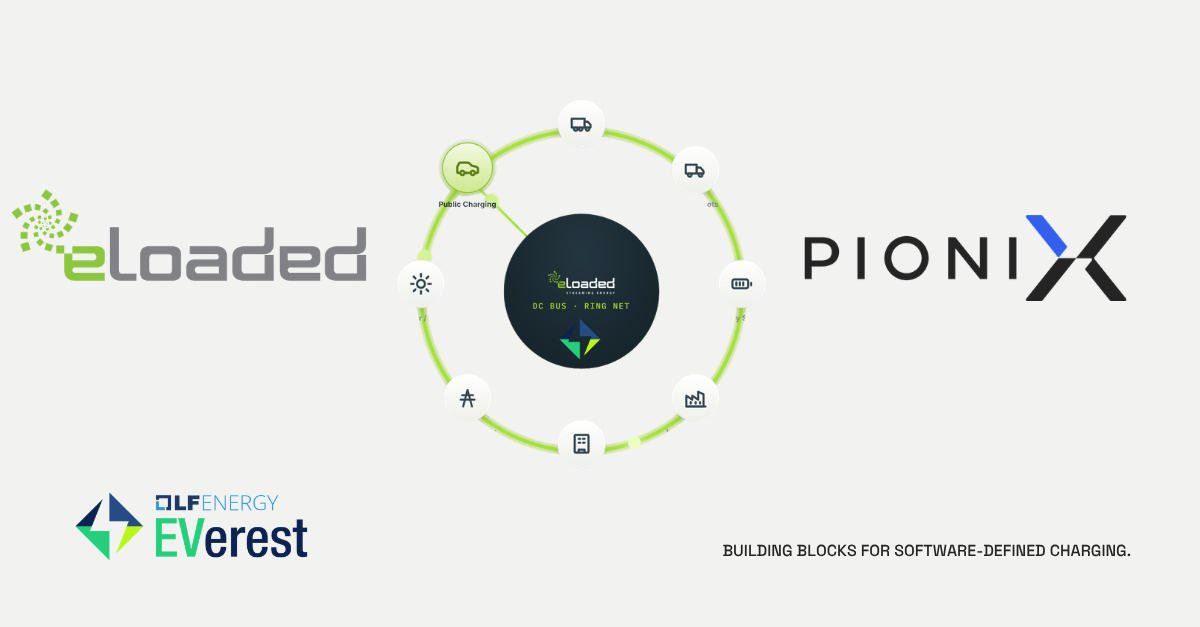
For years, EVerest has powered the conversation between charger and vehicle. This partnership takes that same open, software-defined approach and lets it reach further: into the infrastructure layer that high-power charging sites depend on.
Same principle, one layer up
The idea behind EVerest has always been the same, no matter what kind of charging station it runs on: keep protocols and charging logic in software, keep safety-critical logic cleanly separated, and let new standards arrive through updates instead of hardware replacements.
eLoaded builds high-power DC infrastructure for airports, logistics hubs, fleet depots, and heavy-duty charging corridors, the kind of sites where energy distribution, not the charger itself, is the hard problem. Over the past months, we integrated EVerest into eLoaded's products on top of Pionix ChargeBridge CCS, giving their platform the protocol depth and hardware abstraction that EVerest and ChargeBridge are known for.
What's new: ChargeBridge for MCS and the Asian standards
The headline for this announcement is standards coverage. We're introducing new ChargeBridge versions for MCS (the Megawatt Charging System) and for the Asian standards GB/T, CHAdeMO, and ChaoJi. That means integrating these standards at eLoaded becomes considerably simpler going forward, and it opens the door to better interoperability for heavy-duty and depot charging more broadly.
ChargeBridge does the same job here it always does: it provides the hardware abstraction layer that keeps safety-critical logic separate from the software environment, so new protocols can be added without touching what's already certified and running in the field.
Building on EVerest, not around it
eLoaded uses EVerest as a foundation and extends it for their own customers through their own cloud platform, without modifying the open-source stack itself. EVerest still does what it has always done: manage the protocol layer between charger and vehicle. eLoaded adds the layer above it, through their own CPO backend, for things like load balancing across multiple energy sources and site-wide energy management.
That's the model we want to see more of. The community stack stays community-owned and auditable. Commercial platforms build on top of it, in the open, instead of forking it or replacing it.
In their words
"EVerest was built to support every kind of charging station, from AC wallboxes and public AC points to DC fast chargers and megawatt systems," says Dr. Marco Möller, CEO of Pionix. "eLoaded's DC Grid gives EVerest a home at the infrastructure level, where load management, metering, and energy intelligence actually happen. It shows how flexible EVerest is, and it takes us to the next level."
Frank Steinbacher, CEO of eLoaded, puts it this way: "The DC Grid is the nervous system of every serious charging site. Making it software-defined, and open, means our customers can evolve their infrastructure without tearing it out. Partnering with Pionix brings EVerest's protocol depth and ChargeBridge's abstraction capability straight into our platform."
What comes next
With MCS and the Asian standards now on ChargeBridge's roadmap, the same abstraction layer that made CCS integration fast for eLoaded carries forward into megawatt and cross-region charging. That is the point of building this way: new standards should be a software update, not a redesign.
Want to build on ChargeBridge or EVerest? Get in touch. We welcome EVeryone to EVerest.