Zaptec Brings LFE EVerest to the Zaptec Pro - and The Majority of Existing Stations Come Along for the Ride
Zaptec retrofits their flagship AC charger adding the open-source Linux Foundation Energy EVerest stack, proving what Software-Defined Charging looks like in practice: an entire installed fleet upgraded through software, with the hardware untouched.

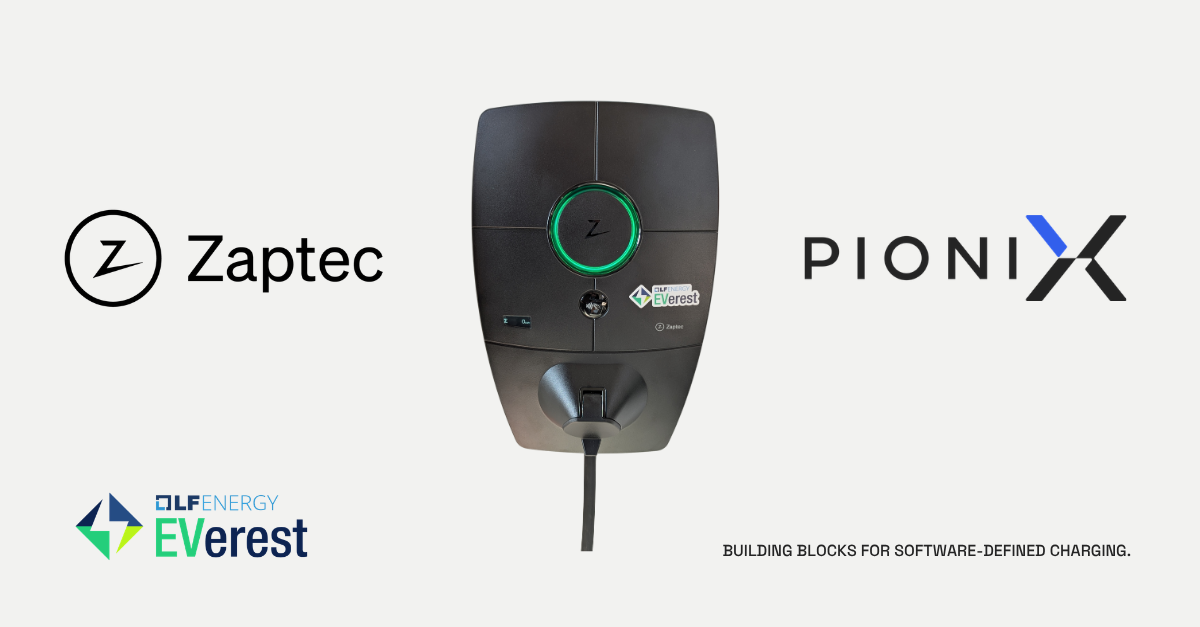
The EV charging industry talks a lot about open source. Zaptec is acting on it.
Pionix is thrilled to announce that Zaptec - one of Europe’s most recognized names in AC charging hardware
- has integrated the open-source EVerest stack into their Zaptec Pro charging station. What makes this
announcement particularly significant is not just that a new product is launching with EVerest. It is that
Zaptec is doing something that very few manufacturers have had the conviction to attempt: they are
retrofitting their existing fleet with a new firmware, built with EVerest, via a staged over-the-air rollout. The
vast majority of installed Zaptec Pro stations already in the field are candidates for an upgrade that
fundamentally changes what the hardware can do - without a single technician dispatched, and without
replacing a single component. This covers Zaptec Pro CC, MID, M&E and T2S versions.
That is Software-Defined Charging in action - and it is a bold move that accelerates the entire industry.
Open Source as the Engine of Software-Defined Charging
Software-Defined Charging only delivers on its promise if the software layer is one worth building upon. A
proprietary firmware can be updated - but those updates are bound by one vendor’s roadmap, one
engineering team’s capacity, and one company’s commercial priorities. Open source changes the equation
entirely.
EVerest is developed by a global community of engineers, OEMs, and protocol specialists, continuously
battle-tested across real deployments and recognized by the Open Charge Alliance as a Golden System
Under Test. When Zaptec utilizes EVerest in their firmware, they are not just updating their software - they
are connecting their hardware to a living ecosystem that improves independently of any single organization.
(Want to go deeper on the SDC concept? We will be linking to a dedicated white paper shortly.)
Native OCPP, Without Compromise
Before this integration, Zaptec Pro stations relied on a proprietary communication layer. With EVerest now
running on the core Zaptec firmware, those same stations gain native OCPP support - the open protocol that
connects chargers to charge point management systems (CPMS) across the industry. This is not a thin
compatibility shim bolted on top of existing logic. It is EVerest’s battle-tested, specification-grade OCPP
implementation, the same one running in deployments worldwide.
For Zaptec Pro operators and the CPOs who manage them, this means cleaner integrations, better
diagnostic data, and a charger that speaks the industry’s language natively - unlocked entirely through
software.
The Quiet Work Behind the Announcement
Pionix had the privilege of supporting Zaptec as a partner throughout this process. The technical depth required to port EVerest onto existing hardware - adapting drivers, validating behavior, and ensuring a safe rollout path for a deployed fleet - is substantial. Zaptec’s engineering team did the hard work. They drove the integration, made the architectural decisions, and built the confidence to commit to a rollout across their installed base. Our role was to be available: as a sounding board, a resource for EVerest internals, and a collaborator on the corners of the stack where institutional knowledge matters.
The result belongs to Zaptec. We are proud to have been part of the journey.
A Fleet That Gets Smarter - Without Touching the Hardware
This is the benefit that deserves to be stated plainly: by adopting EVerest in their software, Zaptec has decoupled the Zaptec Pro’s capabilities from its hardware revision cycle.
In traditional charger architectures, new functionality often meant new hardware - a new controller, a new certification cycle, a costly field replacement. Software-Defined Charging breaks that dependency. With EVerest, the Zaptec Pro’s feature set is no longer frozen at the point of manufacture. Every improvement merged into EVerest by any contributor - whether that is a fix for an edge case in the ISO 15118 handshake, an enhanced smart charging algorithm, improved Plug&Charge certificate handling, or better load balancing logic - becomes something that can flow directly to deployed Zaptec Pro stations in the next firmware release.
This has direct consequences for total cost of ownership. Operators who would otherwise face hardware replacements to meet new protocol requirements or unlock premium features can instead receive those updates over the air. The station’s lifespan extends. The infrastructure investment compounds rather than depreciates. This is what the Software-Defined Charging paradigm promises - and Zaptec’s EVerest integration is a concrete, live demonstration of it.
More Real-World Scale for EVerest
There is another dimension to this announcement that matters to everyone in the EVerest community: scale.
EVerest improves with real-world deployment data. Each integration surfaces edge cases, validates protocol behavior against actual vehicles and backends, and generates the kind of field feedback that no lab setup can fully replicate. Zaptec Pro is one of the most widely deployed AC charging platforms in Europe. Bringing a fleet of this size onto EVerest means a significant expansion of the conditions under which the stack is exercised daily - and that benefits every manufacturer, operator, and integrator building on EVerest.
A larger deployed base is not just a headline. It is infrastructure for making the stack more robust for everyone.
In Their Own Words
“This is exactly the kind of move we built EVerest for. Zaptec showed that you don’t need to ship new hardware to deliver a genuinely better charger - you need the right software. Every station they upgrade is proof that open source and Software-Defined Charging are not future concepts. They are working, today, at scale.” - Marco Möller, CEO & Co-Founder, Pionix
“What excites me most about this integration is what it means for the long term. A Zaptec Pro running EVerest is not the same product it was on the day it shipped - and a year from now, it will be better still. That is the compounding value of connecting your hardware to an open, actively developed stack.” - Marcos Gomes, Product Owner, Zaptec
Rollout Timeline
Zaptec will deliver the new EVerest-based firmware in a staged rollout. This is the responsible approach for any OTA update at fleet scale: it allows issues to be caught early, rollout velocity to be adjusted based on observed behavior, and operators to be supported at each stage. Not all Zaptec Pro stations will receive the update simultaneously. Costumers can request access to the update using the form available in the documentation page.
A Signal to the Market
Decisions like this one send a message that travels further than any product launch. When a manufacturer with Zaptec’s installed base commits to open-source - and backs that commitment by shipping it to existing hardware in the field - it makes the case that Software-Defined Charging is not a future concept. It is happening now, on hardware already installed, at scale.
We believe that will not go unnoticed.
Are you a owner of a Zaptec Pro charging station and want to check if your hardware is eligible for receiving the EVerest-based FW Update?
Check here: OCPP 1.6J for Zaptec Pro
Are you a charger manufacturer evaluating EVerest for a new or existing product?
Get in touch with the Pionix team - we would be glad to walk you through what an integration looks like.