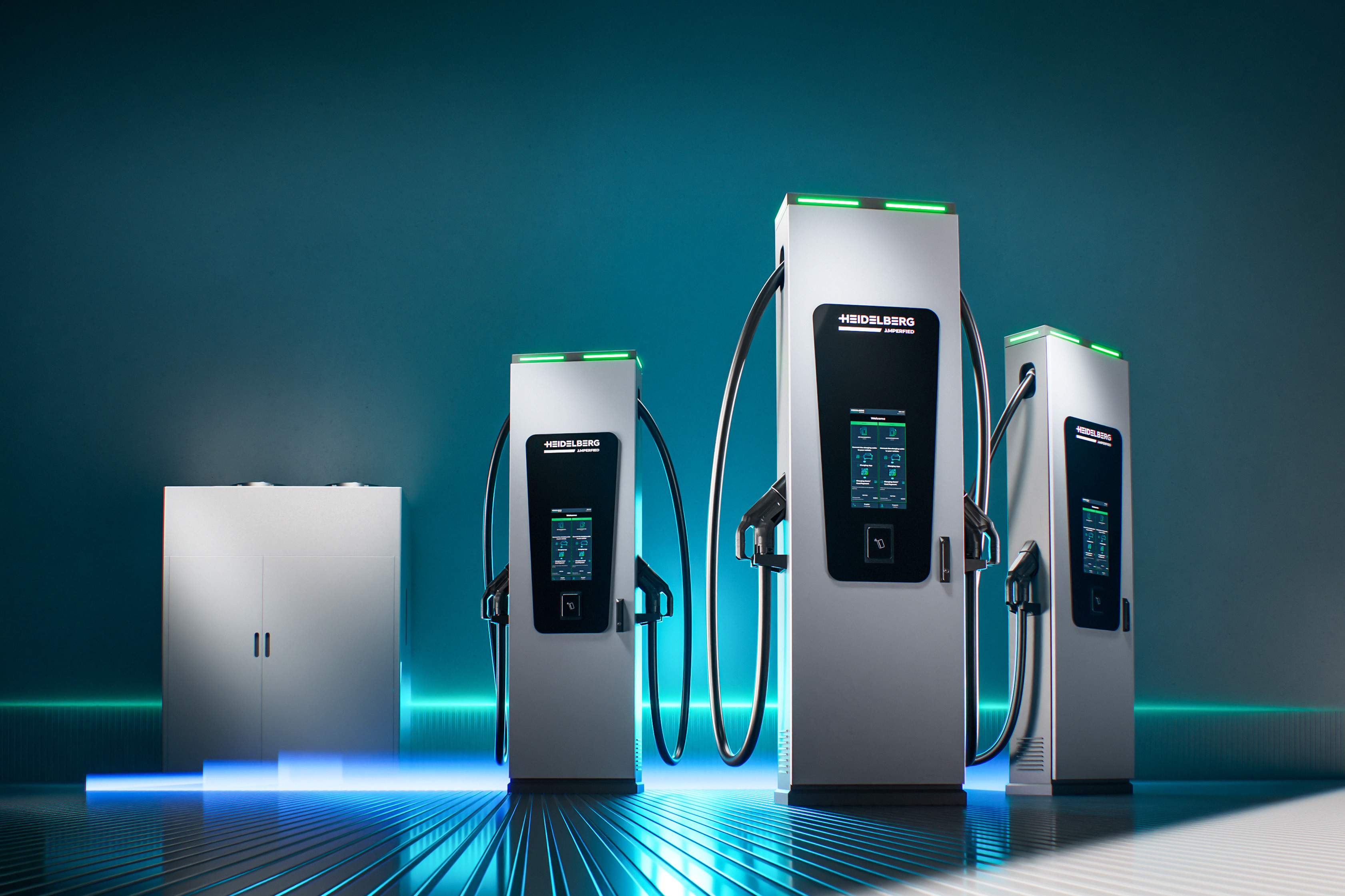
Fast Charging, Smarter Backbone: Amperfied’s Take on Modular Infrastructure
Can fast charging infrastructure be both modular and highly available? Amperfied thinks so – and built its new DC solution on EVerest to prove it.


Sometimes the most valuable partnerships start close to home. When Amperfied - located just 10 kilometers from our headquarters in Southern Germany - decided to expand from AC wallboxes into the demanding world of DC fast charging about a year ago - they needed more than just powerful hardware. They needed a software foundation that could help them compete against very established companies already dominating the market.
What started as early conversations between neighbors quickly evolved into a deep technical collaboration that pushed LFE EVerest to handle challenges we'd never encountered before. Here's what we learned and how it's making our platform stronger for everyone.
The Challenge: Entering a Market Dominated by Established Players
Amperfied, a subsidiary of Heidelberger Druckmaschinen AG and one Germany’s key EV charger manufacturers, came to us with a clear goal: to offer a reliable system that meets the demanding requirements of Charge Point Operators (CPOs). Despite their strong position in the AC wallbox segment, they were venturing into entirely new territory.
The DC fast charging space was already dominated by established players; competing here meant overcoming significant technical and strategic hurdles. DC fast charging isn't just about scaling up power; it's about managing complex interactions between vehicles, backend systems, and grid infrastructure. Industry data shows that connectivity and communication issues are among the leading causes of charging infrastructure failures.
Rethinking Charging Logic: A Collaborative Approach
From our first conversations, it became clear that Amperfied's Dynamic DC architecture would expose gaps in conventional charging software thinking. Their system needed to coordinate power distribution across six dispensers from a single 480kW central unit, with real-time decisions about where to route available capacity based on vehicle charging curves, grid constraints, and demand prediction.
The trust they placed in us from very early on was remarkable. Rather than approaching us with a fixed specification, they wanted to collaboratively shape something new. This wasn't just about scaling up existing protocols; it required rethinking how charging software manages resources, communicates between components, and maintains system reliability when multiple variables are changing simultaneously.
BaseCamp's Modular Architecture: Built for This Complexity
The beauty of the EVerest-based architecture became apparent during our first proof-of-concept with Amperfied. Instead of rebuilding everything from scratch, we could extend existing modules and create new ones specifically for their power management requirements. Here's how EVerest's modularity solved their technical challenges:
Power Distribution Module:
The heart of Amperfied's innovation is a centralized power unit that supplies multiple outlets. This required us to develop completely new algorithms that continuously optimize energy allocation across dispensers based on:
- Real-time vehicle state-of-charge detection
- Grid pricing signals and demand response events
- Predictive modeling of charging session duration
The integration of this power unit became the main component of their EVerest implementation - a custom solution that had to seamlessly coordinate between centralized power electronics and distributed dispensing hardware.
Multi-Dispenser Coordination:
Traditional charging software assumes independent charge points. Amperfied needed tight synchronization between up to 12 charge points sharing common power electronics. We extended EVerest's communication layer to handle:
- Sub-second power reallocation decisions
- Graceful degradation when individual dispensers fail
- Load balancing that considers both electrical and thermal constraints
Advanced Diagnostics:
The distributed architecture created new failure modes that standard monitoring couldn't catch. We enhanced EVerest's diagnostic capabilities to provide better system visibility:
- Component health across the entire power chain
- Communication latency between central unit and dispensers
- Predictive maintenance indicators for power electronics
The ISO 15118 Challenge:
One unexpected complexity emerged during vehicle compatibility testing. ISO 15118 Plug & Charge works well for single-dispenser systems, but coordinating certificate management and secure communication across multiple dispensers sharing power proved challenging.
The solution required deep integration between EVerest's security layer and the power management algorithms - exactly the kind of cross-cutting concern that benefits from our open-source approach.
Real-World Testing: Where Software Meets Hardware Reality
Working with Amperfied set another proof point that DC charging software can't be developed in isolation. Their system exposed edge cases we'd never encountered:
- Thermal Management: High-power charging generates significant heat. EVerest needed to understand thermal constraints across the entire system, not just individual charge points. We added thermal modeling that helps predict when power needs to be throttled before temperatures reach critical thresholds.
- Grid Integration: Dynamic power allocation is meaningless if you can't respond to grid constraints. We enhanced EVerest's OCPP 2.0.1 implementation to handle complex smart charging scenarios where grid signals need to be translated into real-time power distribution decisions across multiple dispensers.
- Power Allocation: Amperfied’s system is capable of distributing power intelligently: either charging multiple vehicles in parallel across different outlets or directing the full high-power output to a single dispenser when needed, for example in heavy-duty vehicle applications. Supporting such dynamic use cases required us to push our protocol implementations further and optimize EVerest for scenarios well beyond standard passenger car requirements, including up to 480 kW on a single connector.
The Interoperability Imperative: More Than Just Technical Compliance
From our earliest discussions, interoperability emerged as a critical success factor, not just with vehicles, but with backend systems across the entire charging ecosystem. For a company transitioning from AC wallboxes to competing against established DC charging giants, proving interoperability wasn't just about technical compliance, it was about market credibility.
The challenge was multifaceted. Amperfied needed to demonstrate that their system could work seamlessly with a wide range of vehicle manufacturers and their differing charging protocols, with various backend systems used by CPOs, with grid management systems to enable smart charging and demand response, and even with future standards and protocols still under development.
This is where EVerest's open-source foundation became invaluable. Recent analysis identifies lack of interoperability as the overarching threat to system reliability and broader EV adoption - by building on EVerest's community-tested protocol implementations, Amperfied could offer the vendor-agnostic reliability that CPOs demand without having to prove every integration from scratch.
What This Means for EVerest's Evolution
The Amperfied project has directly influenced EVerest's roadmap in several key areas:
- Enhanced Power Management APIs: We're exposing more granular control over power allocation, enabling hardware partners to implement custom optimization algorithms while maintaining standards compliance.
- Improved Diagnostics Framework: Diagnostic insights from the Amperfied deployment are helping shape a more universal health monitoring layer in BaseCamp, supporting scalable system visibility for future hardware partners.
- Scalable Architecture Patterns: Supporting Amperfied's distributed design helped us to create a more user friendly way how EVerest handles multi-component systems. These patterns are now available to all our partners building complex charging infrastructure.
The Platform Effect: Accelerating Innovation Through Shared Development
The Amperfied collaboration demonstrates how platform thinking can accelerate innovation in capital-intensive industries. Rather than spending months of protocol development work, they could focus their engineering resources on their core differentiation: intelligent power management and availability-optimized hardware design.
"The combination of not having to reinvent every commodity while still maintaining the ability to stay in the driver's seat at critical points: that's what this solution enables." Niklas Behl, Senior Vice President R&D (CTO) at Amperfied.
Looking Forward: From Insights to Innovation
The success of Amperfied's Dynamic DC platform validates our architectural decisions, but it also points toward new challenges. As charging infrastructure becomes more sophisticated, we're seeing increasing demand for bidirectional charging capabilities that enable Vehicle-to-Grid applications, for advanced energy management systems that factor in renewable generation and storage, for fleet-optimized charging algorithms tailored to logistics use cases, and for predictive maintenance powered by machine learning across diverse hardware platforms.
Each of these developments calls for the kind of cross-platform, standards-based approach that makes EVerest unique in the market.
These industry trends are already driving concrete product innovations at Pionix. With ChargeBridge, we've developed a modular, pre-certified hardware solution that addresses the core challenges manufacturers face when building next-generation charging controllers. The clean separation between safety-critical hardware and software innovation enables exactly the kind of rapid iteration and flexibility that the evolving charging landscape demands.
"ChargeBridge is exactly the solution we would select for a project starting today - fully aligned with our future product strategy." - Niklas Behl.
Building the Future, Together
The most rewarding aspect of working with Amperfied wasn't just solving their technical challenges, it was seeing how our collaboration made both companies stronger. They got a robust software foundation that accelerated their market entry. At the same time, we were able to challenge our modular software architecture with real-world requirements, making EVerest even more capable for everyone.
"We have the clearly formulated ambition to become a leading provider of industrial complete solutions for reliable BEV charging," Behl concluded. "The technical platform is now proven with our first product."
For Pionix, partnerships like this one represent the future of EV charging infrastructure: hardware innovation enabled by flexible, standards-based software platforms that let the best ideas win.